KINESIOLOGY
Uncovering what holds you back

Kinesiology - Listening to the Body's Inner Intelligence
When we feel stressed, overwhelmed or stuck, the body often knows long before the mind does.
Kinesiology is a holistic method that works with the body’s natural intelligence to restore balance and self-regulation.
The term Kinesiology comes from the Greek Kinesis, meaning “movement”, and refers to the study of human movement and function. In holistic Kinesiology, this understanding goes far beyond muscles and joints. It includes the nervous system, energy flow, emotions and mental well-being.
Kinesiology bridges Western knowledge of anatomy and neurology with Eastern principles such as Yin and Yang and the Five Elements. This integrative perspective allows the body to be understood as a dynamic, interconnected system rather than a collection of isolated parts.

How Kinesiology Supports Well-Being
Holistic Kinesiology is widely used for:
-
stress management and nervous system regulation
-
emotional balance and inner stability
-
prevention of health issues,
-
performance and focus enhancement
-
releasing learning, emotional or mental blockages, including in children
It is especially helpful for people who feel emotionally overwhelmed, mentally exhausted or internally stuck, yet continue to function in everyday life.
At the core of Kinesiology is the muscle test, usually performed on the arm or leg. This gentle, non-invasive test acts as a feedback system, allowing the body itself to indicate what it needs in the present moment.
Because the information comes directly from the body, Kinesiology is highly individualized. Each session is guided by your system, not by a fixed protocol.
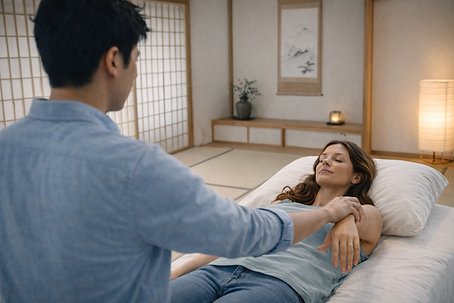

Accessing the Body’s Inner Knowledge
Kinesiology works holistically, taking into account not only the physical body, but also emotional, mental, energetic and environmental influences.
Through this process, subconscious patterns, stored experiences and emotions as well as unresolved stress can surface, not through talking or analysis, but through the body's own signals.
Energetic blockages can be identified and gently released, supporting the body’s natural capacity for balance and self-healing.
Many clients experience:
-
greater mental clarity
-
emotional relief
-
a sense of grounding and stability
-
a deeper connection with themselves
As part of Bruce's holistic health and life coaching, Kinesiology offers a respectful and empowering way to listen to the body, reduce stress and support meaningful, lasting change.
Your body already holds the answers, Kinesiology helps you reconnect with them.